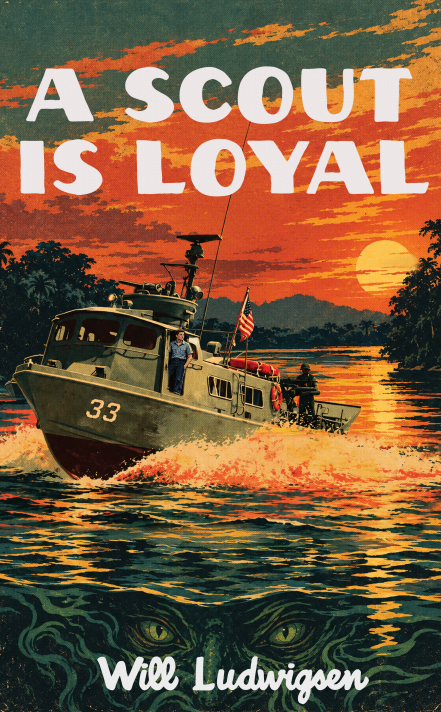
We’ve been keeping this under wraps, but did you know that my new novel, A Scout is Loyal, is emerging from the Mekong Delta in just a few weeks? To pique your interest in the meantime, I’ll be posting here and elsewhere with some thoughts about how the book came about, along with a few other surprises along the way.
Ugh, sequels. As a human programmed by evolution to seek trusted members of my tribe, I hate how easy it is to send a chill up my spine with a familiar character.
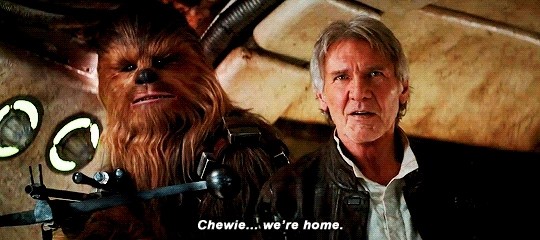
My cynical theory is that sequels are what we have now instead of physical communities: a set of continuing situations and people we can all discuss in common to forge bonds between us. Because we can’t keep talking about a fifty-year-old movie, we need new encounters with those characters to have more reason to talk about our values.
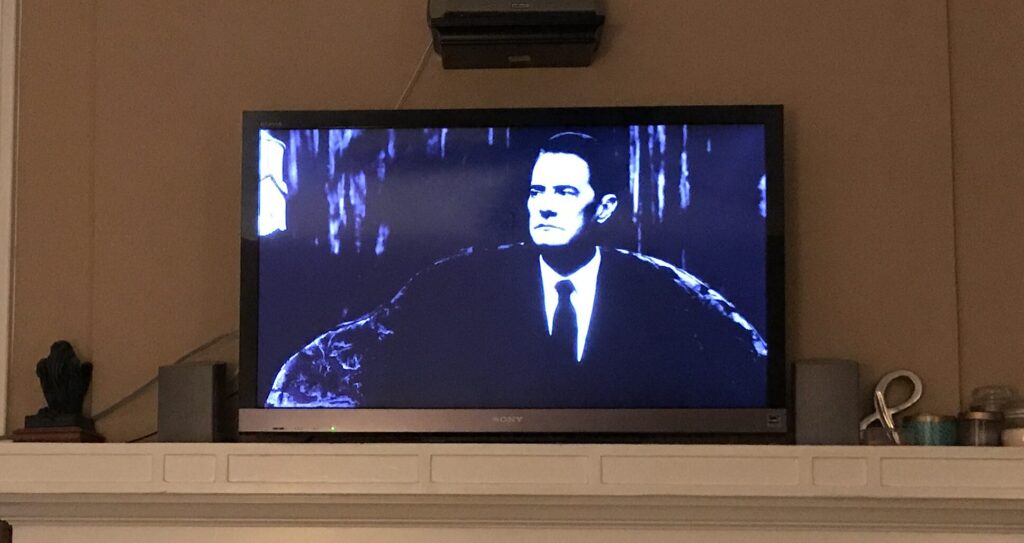
It’s an easy button to push, having an old friend show up on the page or screen. I actually got choked up when Dale Cooper appeared in the third season of Twin Peaks.
I have only a few gold standard sequels: The Empire Strikes Back, Aliens, Terminator 2, Indiana Jones and the Last Crusade, The Wrath of Khan, and The Search for Spock. Among books, The Lord of the Rings1, Finders Keepers, and Silence of the Lambs come to mind…but not many others. As a viewer and a reader, I enjoy the idea of an experience being special and strange, and if I want to feel it again, there’s always the original.2
What turns me off in most sequels is self-awareness, an aura of portentousness when the writers and producers develop a sense of the work as a shared cultural artifact. It invites either hubris (“Fuck you, we’re Game of Thrones“) or pandering (“Someone get me the ghost of Harold Ramis!”), and in both cases, it means you’re paying more attention to meeting an expectation than exceeding one.3
The kind of art I like most appears in the world blinking in surprise that it exists at all. The odds were long, the end uncertain, and the effort dangerously close to futile, but it became real through heroic effort that nobody asked for. In that desperate risk, there is energy and passion to make something succeed that is much more rare when you know an automatic audience is waiting.4
You dress up a little nervously for the first date, and if you’re smart, you don’t show up for the second in Crocs and cargo shorts saying, “What? Aren’t we married?” Instead, you approach the second date (or second book) as another angle of introduction, a deepening of a theme.
In all candor, I barely managed to write A Scout is Brave5, and I never expected anyone to want a sequel…especially me. I was pleasantly surprised by the positive reactions it received and more so by the interest from some readers to find out what happened next to Bud Castillo.
The more I thought about it, the more curious I was about Bud’s next adventure, too. Once you’ve thwarted Deep Ones in Innsmouth, what’s next?
Vietnam, it turns out.
A quirk of my writing process is that I rarely remember the writing process. I know intellectually that it involves a lot of typing and handwriting and talking to myself on the page and jamming puzzle pieces together, but after it becomes a finished thing, the story feels inevitable. I call it the “shiver of recognition” that comes at the end, as though it always existed.
So when I began writing ASL on July 18, 2024, I approached it like another first book instead of a sequel. For one thing, it may well be someone’s first exposure to the “franchise,” and for another, I was just as nervous about making a good impression. I didn’t take your good will for granted.
The book that resulted feels like it has second date energy: we felt some sparks during our first meeting but now it’s time to see where else we can go.
Care to join me?

- A sequel to The Hobbit, of course. ↩︎
- I re-read a lot of books, largely as medicine to feel a certain way at a certain time. Sometimes, I’m not up for the risk of a new feeling. ↩︎
- Don’t get me started on the whole “confounding fan expectations” bullshit. ↩︎
- Which isn’t to say that all art should be grueling or stressful to create. What I’m talking about here is a sense of experimentation. ↩︎
- Which took over a decade of hacking away, plus another year and a half of sitting in a famous publisher’s slush pile before it found its true home with Lethe. ↩︎