Stories of Weird Mystery

Category: A Scout is Loyal

Algernon Blackwood is My Scoutmaster

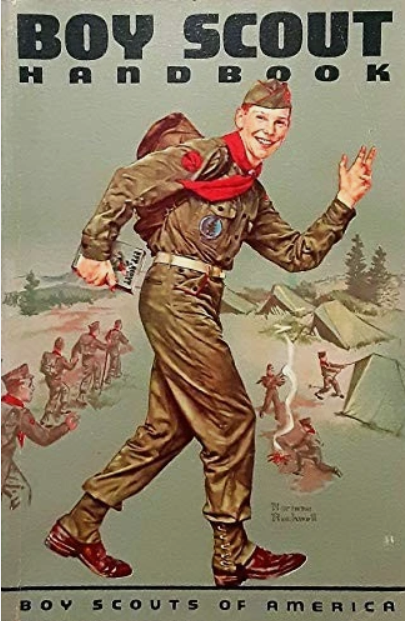
The 1963 Boy Scout Handbook that my father gave me at age nine led me to believe that I would venture into the woods with like-minded seekers to stand awestruck beneath towering redwoods1 and then we’d carry that humility back to lives of service to humanity.2

When I joined the Scouts a few years later, I seemed to be the only one hoping for a sublime experience in the woods. Everyone else was there mostly to burn things and flirt with fascism, including my father who was the Assistant Scoutmaster.

What I didn’t know then was that my true Scoutmaster had died twenty-two years before I was born: British writer, outdoorsman, dairy farmer, Theosophist, occultist, radio broadcaster, and perceptive oddball Algernon Blackwood.
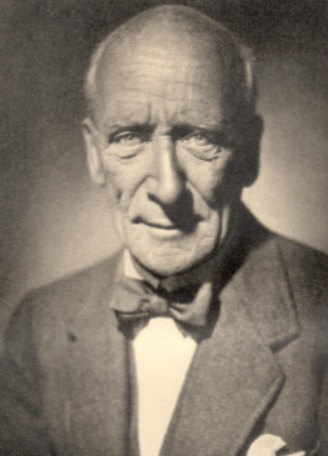
Algernon Blackwood, wearing his most ominous bowtie.

Blackwood (1869 – 1951) wrote and performed ghost stories often set in the wilderness where his “lonely but fundamentally optimistic protagonists”3 encountered escalating signs that they were not alone (or often welcome) amongst the ageless sentinels of nature.

Ghost story scholar Jack Sullivan called him a “combination of mystic and outdoorsman,” which strikes me as a far better Scoutmaster for a campfire than some middle-aged guy spouting off from a lawn chair about how the Russians are going to invade.

I mean, how’s this for a Scout Law?

My fundamental interest, I suppose, is signs and proofs of other powers that lie hidden in us all; the extension, in other words, of human faculty.

Is that too much to ask from a camping trip, that I experience the subtle vibrations of the universe in my bones, hints of some deep and ancient intelligence of which I am but a fleeting expression?

Spoiler alert: yes.

My Scout career had plenty of weirdness4, but all too little of the numinous, which wasn’t for lack of searching. I was prone to wandering away from campsites looking for burial mounds or a pirate’s cabin, neither of which seemed implausible in feral Florida.

The closest I came (and it wasn’t very close) was during one of my three summers at Camp Flying Eagle. For a week, we took “classes” for merit badges, slept in old military tents or rotting cabins that were worse, ate from dented aluminum utensils in a big mess hall, and tromped around on trails through the scrabble pines and primordial palmetto bushes. I didn’t really mind any of that because obviously there could be something wondrous and strange around any corner.
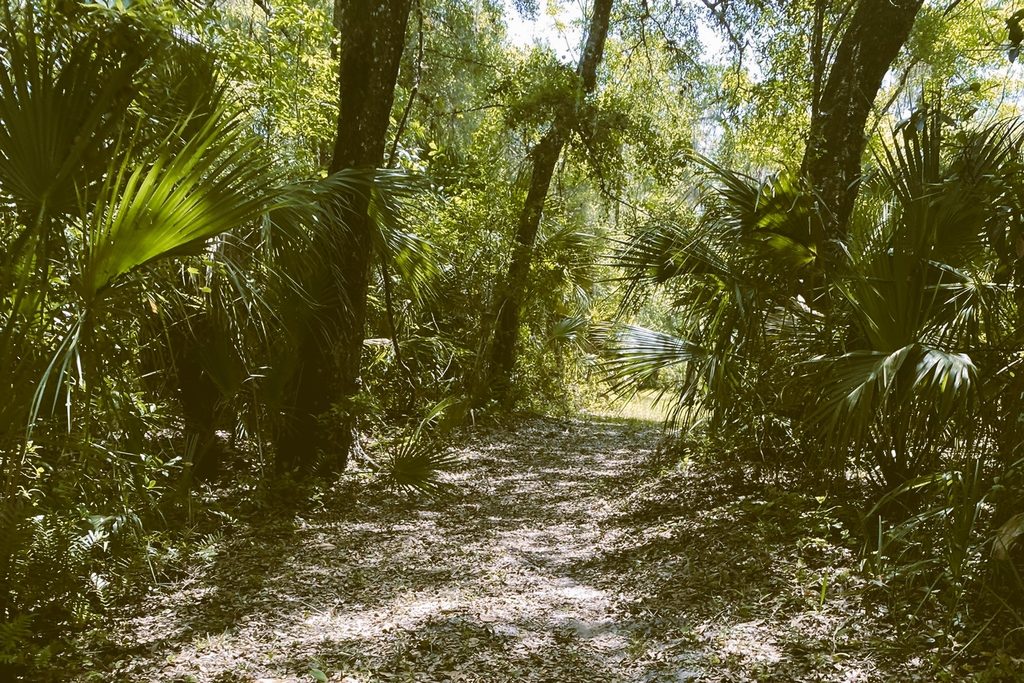
This is from a recent visit but the vibe is the same. The water level was higher when I was a kid, though.
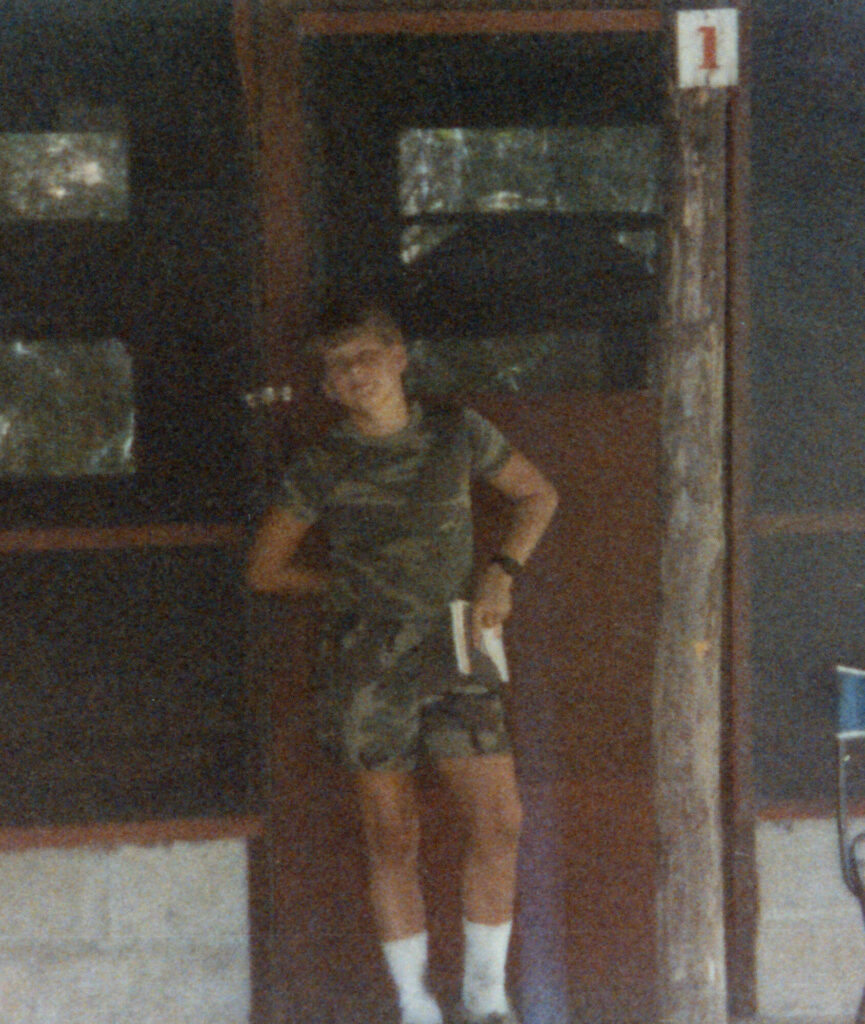
Your author, hanging out at the Marie Selby cabins. Notice he’s got a book.

My favorite part of the camp was near the area called Marie Selby (named for a Sarasota philanthropist), situated amid the taller and shadier oaks at what was then a far edge of the property. I’d strike out from the cabins and wander through the cypress swamp, a marshy patch of knobby tree roots (“knees”) jutting from the muck.

I remember being mildly nervous each time I went out. In Florida, it’s common to see alligators lurking in any sizeable body of water, and venomous cottonmouths could easily be slithering camouflaged by the ooze. I saw no need to startle them, so I walked as the handbook suggested by stepping on my heel first and then letting my foot roll forward silently to the toe

Once when I ventured farther than usual from camp, I came upon a path of springy wooden planks built across the stumps and cypress knees. I followed them carefully through the swamp for a surprisingly long way as the cicadas droned around me from all directions, sometimes surging as though they were closing in.

I zigged and zagged my way to the terminus of the path, an enormous oak or cypress stump about the size of a Volkswagen and covered in lichen and moss. It reminded me of Yoda’s house on Dagobah, and of course, I circled it looking for an obvious entrance.

There wasn’t one, at least not that presented itself to me.

What struck me as I stood there looking around was that this was not an obvious destination. There was no place to sit (nor much of one to stand), and there wasn’t any placard identifying some natural object like elsewhere in camp. Someone had dragged salvaged lumber out into the swamp, strategically placed them on the most stable spots, and then stopped at a giant stump5.

It wasn’t a noise that jolted me into action or anything I could see, just a sudden Blackwood-ian realization that I was standing in a spot where normal logic didn’t apply. Someone built this for hidden reasons, and I assumed they couldn’t be good.6

In a surprising display of balance, I hurried back across the boards with some of them cracking beneath me—not quite a run but certainly not a stroll. Did the cicadas stop their chatter to watch me go? I don’t remember, but it would have been the least they could do.

That’s it. That was essentially my only remotely sublime Boy Scouting experience. It would have been nice to consult with Scoutmaster Blackwood that night around the campfire, comparing notes of our psychic impressions, but we probably just went to the mess hall to eat watery spaghetti.
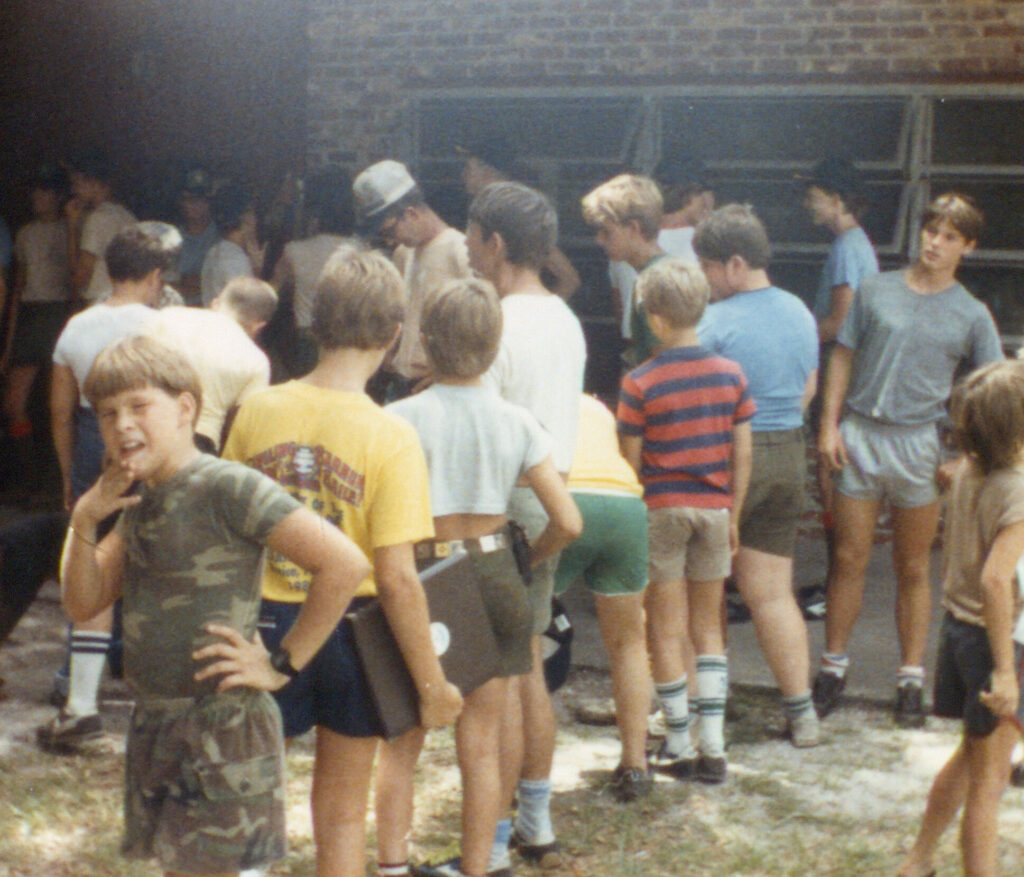
Here I am waiting in line at that mess hall.

I never found a body in the woods or discovered mysterious coquina megaliths, but I’ve had a few experiences of awe and wonder since. When I haven’t, I’ve filled the gap the same way Algernon Blackwood did, by writing stories. I haven’t come close to his masterpieces of natural horror “The Willows” or “The Wendigo,” but I did create a troop of Wonder Scouts led by Charles Fort (“We Were Wonder Scouts”) and wrote a couple of books about a troop in Innsmouth.

As a small gift to you for this Halloween season, I’ve read a portion of Blackwood’s famous story “The Willows.” Download it and play it while getting ready for trick-or-treaters or stoking some embers in your backyard firepit.

  1. Not available in Florida. Your mileage may vary. ↩︎
  2. In my defense for this deranged impression, the text and illustrations in the handbook (not to mention the Norman Rockwell cover) somewhat oversold the link between Nature and…human nature. ↩︎
  3. Jack Sullivan’s wonderful phrase. ↩︎
  4. Pulling a kid from a creek full of thrashing gar, for instance, or falling down a mound of fill dirt to get a concussion on a rock. ↩︎
  5. Later to appear in my story “Acres of Perhaps.” ↩︎
  6. The most logical reason, that it was built by a weirdo like me, didn’t register. I was the kind of kid who still looked in the woods for evidence of gnomes and Bigfoot. ↩︎
We All Squeal for Sequels, Unfortunately

We’ve been keeping this under wraps, but did you know that my new novel, A Scout is Loyal, is emerging from the Mekong Delta in just a few weeks? To pique your interest in the meantime, I’ll be posting here and elsewhere with some thoughts about how the book came about, along with a few other surprises along the way.


Ugh, sequels. As a human programmed by evolution to seek trusted members of my tribe, I hate how easy it is to send a chill up my spine with a familiar character.

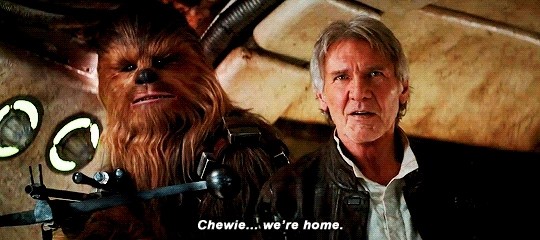
When I saw this in the theater with my mother, she elbowed a stranger and told them she’d taken me to see the original in 1977.

My cynical theory is that sequels are what we have now instead of physical communities: a set of continuing situations and people we can all discuss in common to forge bonds between us. Because we can’t keep talking about a fifty-year-old movie, we need new encounters with those characters to have more reason to talk about our values.

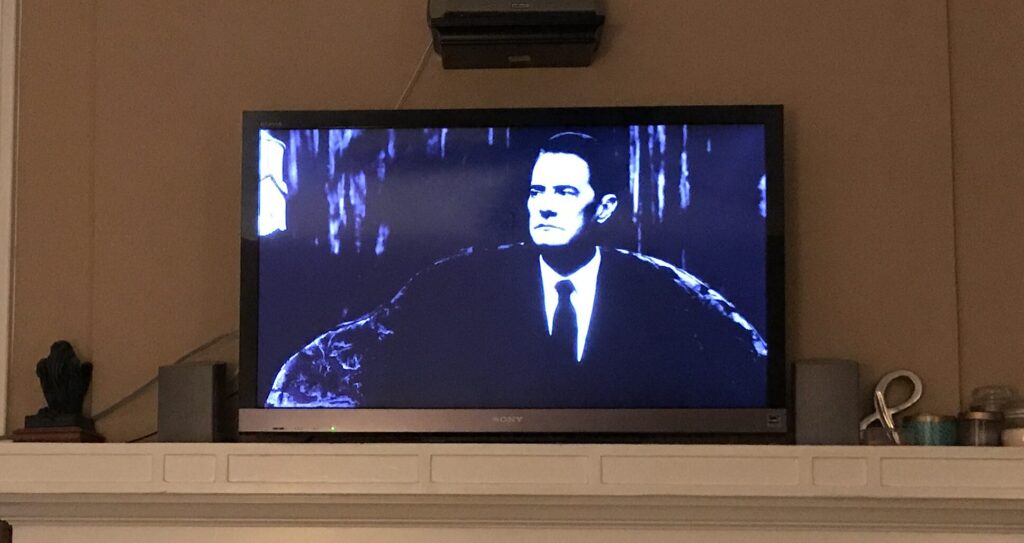
It’s an easy button to push, having an old friend show up on the page or screen. I actually got choked up when Dale Cooper appeared in the third season of Twin Peaks.

I even took a picture of it, amazed to be seeing him again.

I have only a few gold standard sequels: The Empire Strikes Back, Aliens, Terminator 2, Indiana Jones and the Last Crusade, The Wrath of Khan, and The Search for Spock. Among books, The Lord of the Rings1, Finders Keepers, and Silence of the Lambs come to mind…but not many others. As a viewer and a reader, I enjoy the idea of an experience being special and strange, and if I want to feel it again, there’s always the original.2

What turns me off in most sequels is self-awareness, an aura of portentousness when the writers and producers develop a sense of the work as a shared cultural artifact. It invites either hubris (“Fuck you, we’re Game of Thrones“) or pandering (“Someone get me the ghost of Harold Ramis!”), and in both cases, it means you’re paying more attention to meeting an expectation than exceeding one.3

The kind of art I like most appears in the world blinking in surprise that it exists at all. The odds were long, the end uncertain, and the effort dangerously close to futile, but it became real through heroic effort that nobody asked for. In that desperate risk, there is energy and passion to make something succeed that is much more rare when you know an automatic audience is waiting.4

You dress up a little nervously for the first date, and if you’re smart, you don’t show up for the second in Crocs and cargo shorts saying, “What? Aren’t we married?” Instead, you approach the second date (or second book) as another angle of introduction, a deepening of a theme.

In all candor, I barely managed to write A Scout is Brave5, and I never expected anyone to want a sequel…especially me. I was pleasantly surprised by the positive reactions it received and more so by the interest from some readers to find out what happened next to Bud Castillo.

The more I thought about it, the more curious I was about Bud’s next adventure, too. Once you’ve thwarted Deep Ones in Innsmouth, what’s next?

Vietnam, it turns out.

A quirk of my writing process is that I rarely remember the writing process. I know intellectually that it involves a lot of typing and handwriting and talking to myself on the page and jamming puzzle pieces together, but after it becomes a finished thing, the story feels inevitable. I call it the “shiver of recognition” that comes at the end, as though it always existed.

So when I began writing ASL on July 18, 2024, I approached it like another first book instead of a sequel. For one thing, it may well be someone’s first exposure to the “franchise,” and for another, I was just as nervous about making a good impression. I didn’t take your good will for granted.

The book that resulted feels like it has second date energy: we felt some sparks during our first meeting but now it’s time to see where else we can go.

Care to join me?

  1. A sequel to The Hobbit, of course. ↩︎
  2. I re-read a lot of books, largely as medicine to feel a certain way at a certain time. Sometimes, I’m not up for the risk of a new feeling. ↩︎
  3. Don’t get me started on the whole “confounding fan expectations” bullshit. ↩︎
  4. Which isn’t to say that all art should be grueling or stressful to create. What I’m talking about here is a sense of experimentation. ↩︎
  5. Which took over a decade of hacking away, plus another year and a half of sitting in a famous publisher’s slush pile before it found its true home with Lethe. ↩︎

A Scout is Loyal coming in fast!

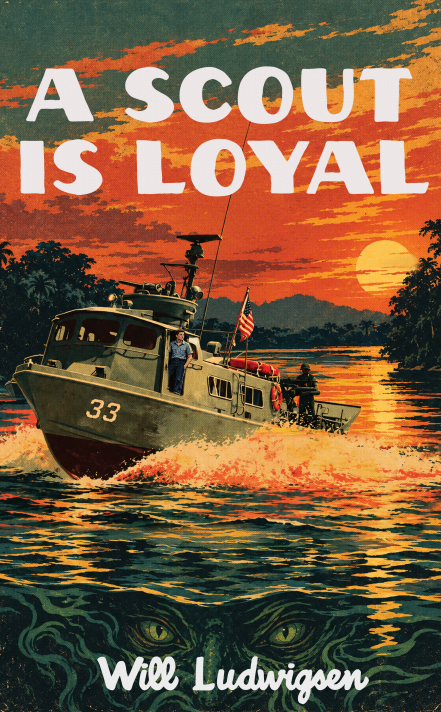
Brave members of the troop, we’re happy to announce that we have a cover for my upcoming release, A Scout is Loyal:

Cover by the talented Jeremy John Parker.

In 1963, thirteen-year-old Bud Castillo and his friend Aubrey Marsh thwarted a conspiracy to unleash ancient horrors from beneath Devil’s Reef in Innsmouth, Massachusetts.

Six years later, still mourning Aubrey’s sacrifice, he finds that serving in Vietnam aboard a Swift Boat feels uncomfortably familiar: a battle of deranged true believers trying to get their hands on something ancient and hungry. This time, Bud will need more than a Scout’s sense of duty to survive it…especially when a ghost from Innsmouth challenges his loyalties. 

“Intense… The unusual blend of war story and Lovecraftian horror leads to a shocking finale… a horror story that gets to a deeper truth.”
—Publishers Weekly

Yes, I’ll take questions at this time.

What do YOU know about the Vietnam War?

Just what my middle-aged white guy research has told me, which still puts me ahead of Lyndon Johnson and Robert McNamara!

What if I haven’t read the first book?

This would be a wonderful opportunity to do so, as the book is still available in a variety of formats. That said, if you insist on not reading it, the story in A Scout is Loyal can stand on its own, though you’ll miss some significant emotional impact.

Is this book violent or scary?

Well, I mean, it takes place during the Vietnam War, but I haven’t gone out of my way to imbue that conflict with additional horror just for a genre audience. There’s eeriness and unease and the occasional burst of confusing violence, just like the real war.

Is this book ‘woke’?

In it, I take the controversial position that we had no idea what the fuck we were doing in Vietnam and that our idealistic American confidence did us no favors. We acted on the world as we wanted it to be, not how it was.

Are you writing books for all twelve tenets of the Scout Law?

Jesus, I hope not. There’s a third one in progress and a small but vocal group agitating for more after that, but I can’t imagine getting to all twelve. Who wants to read A Scout is Courteous or A Scout is Thrifty?

I’m a reviewer, blogger, or podcaster interested in reviewing this book. Where can I get an advance copy?

Reach out to my contact form and I’ll be happy to get you one! It’ll be a relief to receive something other than an AI-generated pitch from a book promoter.

When and where can I get my Deep One claws on this book?

I thought you’d never ask. The book will surge from the misted jungles of the Mekong Delta in mid November, but keep watch for announcements of the official launch and some other surprises.

If you’d like to join up now with a preorder, click below!

© 2026 Will Ludwigsen

Theme by Anders Noren — Up ↑