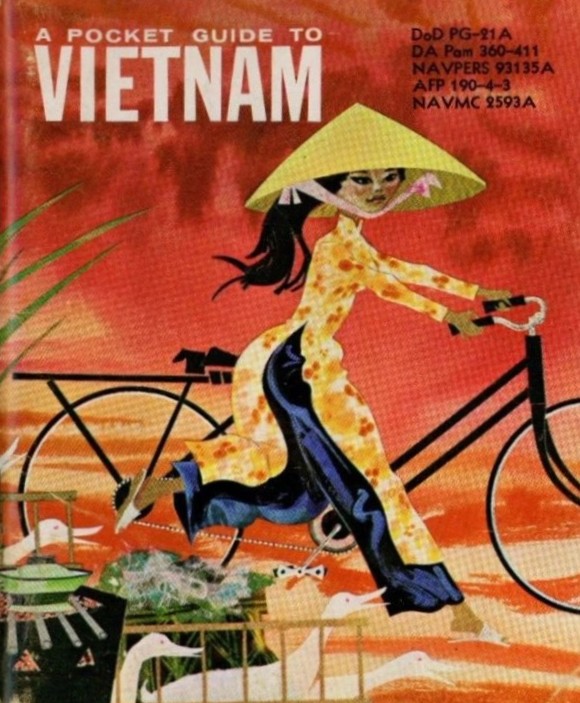
It’s no secret that I have a thing for handbooks. I love the idea that someone sits down with utter confidence that, “Hey, here’s everything you need to know about how to build a model railroad, fix a 1973 Volkswagen bus, or run the U.S. Senate.”
Or, in this case, how not to be an asshole in Vietnam.
A Pocket Guide to Vietnam was distributed (somewhat spottily) to American troops, who applied its lessons also spottily.
In A Scout is Loyal, Bud Castillo is both pleased and bemused by receiving yet another handbook. Enjoy his thoughts in this exclusive excerpt from the novel!
Serving in Vietnam turned out to be just like the Boy Scouts: halfwits starting fires in the woods, officious leaders enforcing the letter of the law instead of the spirit, and damp socks bloating your feet into white flaccid loaves.
They even gave us a handbook, A Pocket Guide to Vietnam, which was perfect to consult when you were slithering desperately under muddy banyan roots for cover or running for your life from mortar shells exploding in a sinking Swift Boat.
“Remember we are special guests here,” it told us.
“Join with the people!” it exhorted. “Understand their life, use phrases from the language, and honor their customs and laws.”
“Reflect honor upon yourself and the United States of America,” it pleaded.
“Your good manners, thoughtfulness, and restrained behavior will be appreciated by the Vietnamese,” it claimed.
I’m a man doomed to be haunted by other people’s handbooks, mostly by taking them more seriously than anyone else, even their authors. I tried my best to reflect honor and show good manners during my time in-country, but I’m not sure how appreciated I was by the Vietnamese. Better to say that some of the Vietnamese and I appreciated one another, all of us exhausted by someone else’s deranged ideas of right and wrong and justice and destiny.
The world doesn’t need another book about how the Vietnam War was a pageant of folly and mass delusion, pretending we could have known better. It doesn’t need one that justifies the war as a “necessary mistake,” either, a disaster later made “worth it” by the eventual fall of Communism in some places across the world. That’s a concept my friends who died there would reject with foul language and rude gestures.
The war doesn’t have to mean anything, though it does have meaning for a lot of us who were there, even briefly in my case. At the time, it felt beyond all meaning like a natural disaster, inevitable like a lightning strike or tsunami.
Except I know now it was less natural than that, and so does my friend Aubrey Marsh, who wanted more than most of us to make that war matter.
There’s more where that come from! Get your own copy here: